
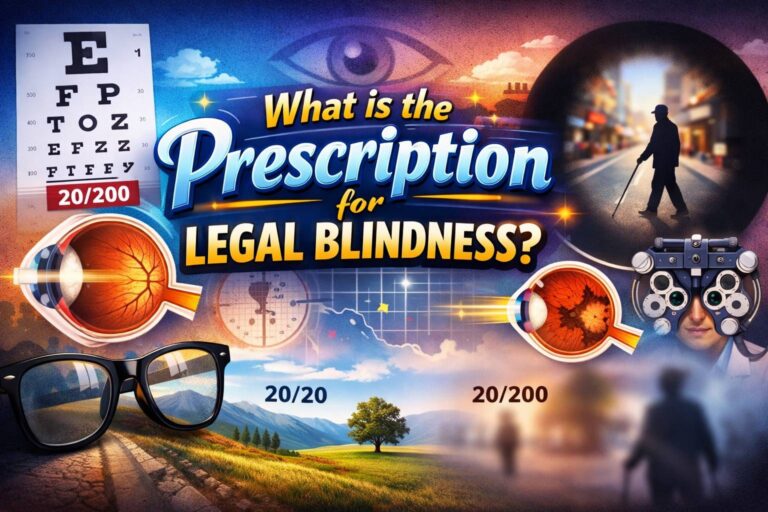
What Is the Prescription for Legal Blindness
Legal blindness is not defined by a single prescription number alone. Instead, it is a medical and legal classification based on specific measurements of visual acuity and visual field, even when a person is wearing the best possible corrective lenses. Understanding what “prescription for legal blindness” really means requires separating everyday eyeglass prescriptions from the clinical standards used by doctors, governments, and disability programs.
This guide explains the exact prescription ranges involved, how legal blindness is diagnosed, how it differs from total blindness, and what it means in real life for work, driving, benefits, and treatment options.
Understanding the Term “Legal Blindness”
Legal blindness is a formal definition, not a description of complete vision loss. A person who is legally blind may still see shapes, colors, movement, or even read large print, but their vision falls below legally established thresholds.
The definition exists to:
-
Determine eligibility for disability benefits
-
Set rules for driving and workplace accommodations
-
Standardize access to visual assistance services
-
Establish protections under disability laws
In the United States and many other countries, legal blindness is determined using best-corrected vision, meaning vision after glasses, contact lenses, or other standard corrections are applied.
The Two Medical Criteria for Legal Blindness
A person is considered legally blind if either of the following conditions is met in the better-seeing eye:
Visual Acuity Criterion
-
Visual acuity of 20/200 or worse with best possible correction
Visual Field Criterion
-
Visual field of 20 degrees or less
Meeting one of these criteria is sufficient for a legal blindness diagnosis.
What Does 20/200 Vision Actually Mean
Visual acuity is measured using a Snellen eye chart.
-
20/20 vision is considered standard normal vision
-
20/200 means what you can see at 20 feet, a person with normal vision can see at 200 feet
This level of vision represents a 90 percent loss of visual clarity, even with correction.
How This Relates to Prescription Strength
Eyeglass prescriptions are written in diopters (for example, -10.00 or +8.00), but there is no single prescription number that equals legal blindness.
Why:
-
Two people with the same prescription can have very different visual acuity
-
Eye diseases can limit clarity even with strong lenses
-
Glasses correct focus, not retinal or optic nerve damage
A person may have:
-
A very strong prescription and not be legally blind
-
A moderate prescription and still be legally blind due to eye disease
Visual Field Loss and Legal Blindness
Legal blindness can also be diagnosed through visual field testing, even if central vision seems usable.
What Is Visual Field
Visual field refers to how much you can see side-to-side and up-and-down while looking straight ahead.
-
Normal visual field: about 180 degrees
-
Legal blindness threshold: 20 degrees or less
This is sometimes called tunnel vision.
Conditions Commonly Causing Visual Field Loss
-
Glaucoma
-
Retinitis pigmentosa
-
Advanced diabetic eye disease
-
Stroke-related vision damage
-
Brain or optic nerve injuries
Someone with tunnel vision may read an eye chart well but still be legally blind because their peripheral vision is severely restricted.
Can Glasses or Contacts Fix Legal Blindness
No. Legal blindness is defined after best correction.
If glasses, contacts, or standard lenses can improve vision above:
-
20/200 acuity, or
-
20-degree visual field
Then the person is not legally blind.
Legal blindness indicates permanent or non-correctable vision loss using ordinary corrective methods.
Is There a Specific Eyeglass Prescription for Legal Blindness
This is a common misconception.
The Short Answer
There is no fixed eyeglass prescription that automatically equals legal blindness.
Why Prescription Alone Is Not Enough
-
Prescription measures refractive error, not clarity
-
Eye disease affects how the brain receives visual signals
-
Scarred retinas or damaged optic nerves cannot be corrected by lenses
For example:
-
A person with -15.00 prescription may see 20/40 with correction
-
Another person with -4.00 prescription may see only 20/400 due to retinal damage
Legal blindness is determined by functional vision, not lens power.
Medical Conditions That Commonly Lead to Legal Blindness
Legal blindness can result from many conditions, including:
Retinal Disorders
-
Macular degeneration
-
Retinal detachment
-
Retinitis pigmentosa
Optic Nerve Damage
-
Advanced glaucoma
-
Optic neuritis
-
Traumatic optic neuropathy
Systemic Diseases
-
Diabetes-related eye damage
-
High blood pressure complications
-
Autoimmune conditions affecting vision
Congenital and Genetic Conditions
-
Albinism
-
Congenital cataracts
-
Inherited retinal diseases
Neurological Causes
-
Stroke
-
Brain tumors
-
Head injuries affecting visual processing
How Doctors Diagnose Legal Blindness
Diagnosis requires comprehensive eye examinations, not just reading glasses tests.
Tests Commonly Used
-
Best-corrected visual acuity testing
-
Automated visual field testing
-
Retinal imaging
-
Optic nerve evaluation
-
Contrast sensitivity testing
Results are documented formally because legal blindness status affects disability claims, accommodations, and driving eligibility.
Legal Blindness vs Total Blindness
These terms are often confused but are medically different.
Legal Blindness
-
Some usable vision remains
-
May detect light, shapes, movement, or colors
-
May read large print or use magnification
-
Vision is insufficient for normal daily tasks without assistance
Total Blindness
-
No light perception at all
-
Extremely rare
-
Represents complete vision loss
Most people classified as legally blind are not totally blind.
What Legal Blindness Means for Daily Life
Being legally blind affects many areas of life, but it does not mean loss of independence.
Driving
-
People who are legally blind cannot drive without special bioptic exceptions (where allowed)
-
Most regions prohibit standard driver’s licenses at this level
Employment
-
Employers must provide reasonable accommodations
-
Many legally blind individuals work full-time using assistive tools
Reading and Technology
-
Screen readers
-
Magnification software
-
Braille displays
-
Voice-controlled devices
Mobility
-
White cane training
-
Orientation and mobility instruction
-
Guide dogs for those who qualify
Does Legal Blindness Qualify for Disability Benefits
Yes, in many countries legal blindness qualifies automatically for disability recognition, though documentation is required.
Common Benefits
-
Disability income support
-
Tax benefits
-
Workplace accommodations
-
Accessible education services
-
Reduced transportation costs
Eligibility rules vary, but legal blindness is widely recognized as a qualifying condition.
Can Legal Blindness Improve Over Time
It depends on the cause.
Potentially Reversible Causes
-
Untreated cataracts
-
Certain inflammatory conditions
-
Some retinal swelling cases
Typically Permanent Causes
-
Advanced glaucoma
-
Genetic retinal diseases
-
Optic nerve damage
-
Severe macular degeneration
Even when vision cannot be restored, functional ability often improves through rehabilitation and assistive technology.
Vision Rehabilitation for Legally Blind Individuals
Rehabilitation focuses on maximizing remaining vision and independence.
Common Rehabilitation Tools
-
High-powered magnifiers
-
Electronic reading devices
-
Contrast enhancement training
-
Orientation and mobility services
-
Daily living skill coaching
Rehabilitation can significantly improve quality of life, even when medical treatment cannot restore vision.
Common Myths About Legal Blindness
Myth 1: You Must Have Extremely Thick Glasses
False. Prescription strength alone does not determine legal blindness.
Myth 2: Legal Blindness Means Complete Darkness
False. Most legally blind people retain some vision.
Myth 3: Legal Blindness Cannot Be Diagnosed Unless You Are Elderly
False. It can affect people of any age, including children.
Myth 4: Nothing Can Help After Diagnosis
False. Rehabilitation and technology offer substantial support.
When to Seek an Eye Examination
You should seek immediate evaluation if you experience:
-
Sudden vision loss
-
Rapid narrowing of side vision
-
Severe distortion or missing central vision
-
Persistent blurry vision that does not improve with glasses
-
Light sensitivity combined with vision changes
Early diagnosis can sometimes prevent progression to legal blindness.
Frequently Asked Questions (FAQs)
What is the prescription for legal blindness
There is no single eyeglass prescription that defines legal blindness. Legal blindness is diagnosed when best-corrected vision is 20/200 or worse in the better eye, or when visual field is limited to 20 degrees or less.
Can someone be legally blind and still read
Yes. Many legally blind individuals can read using large print, magnification, or electronic devices.
Is legal blindness permanent
It depends on the cause. Some cases are treatable, but many are permanent and managed through rehabilitation rather than medical correction.
Can legal blindness be corrected with surgery
Sometimes. Conditions like cataracts may improve significantly with surgery, while optic nerve or retinal damage usually cannot be fully corrected.
Is legal blindness the same worldwide
No. While many countries use similar standards, specific definitions and benefit eligibility rules may vary slightly by region.
Final Thoughts
Legal blindness is not defined by a pair of glasses or a single prescription number. It is a functional diagnosis based on how clearly and widely a person can see with the best possible correction. Understanding this distinction helps remove confusion, reduces stigma, and highlights the importance of early diagnosis, rehabilitation, and accessibility.
For many people, legal blindness is not the end of independence, but the beginning of adapting with the right tools, support, and medical care.